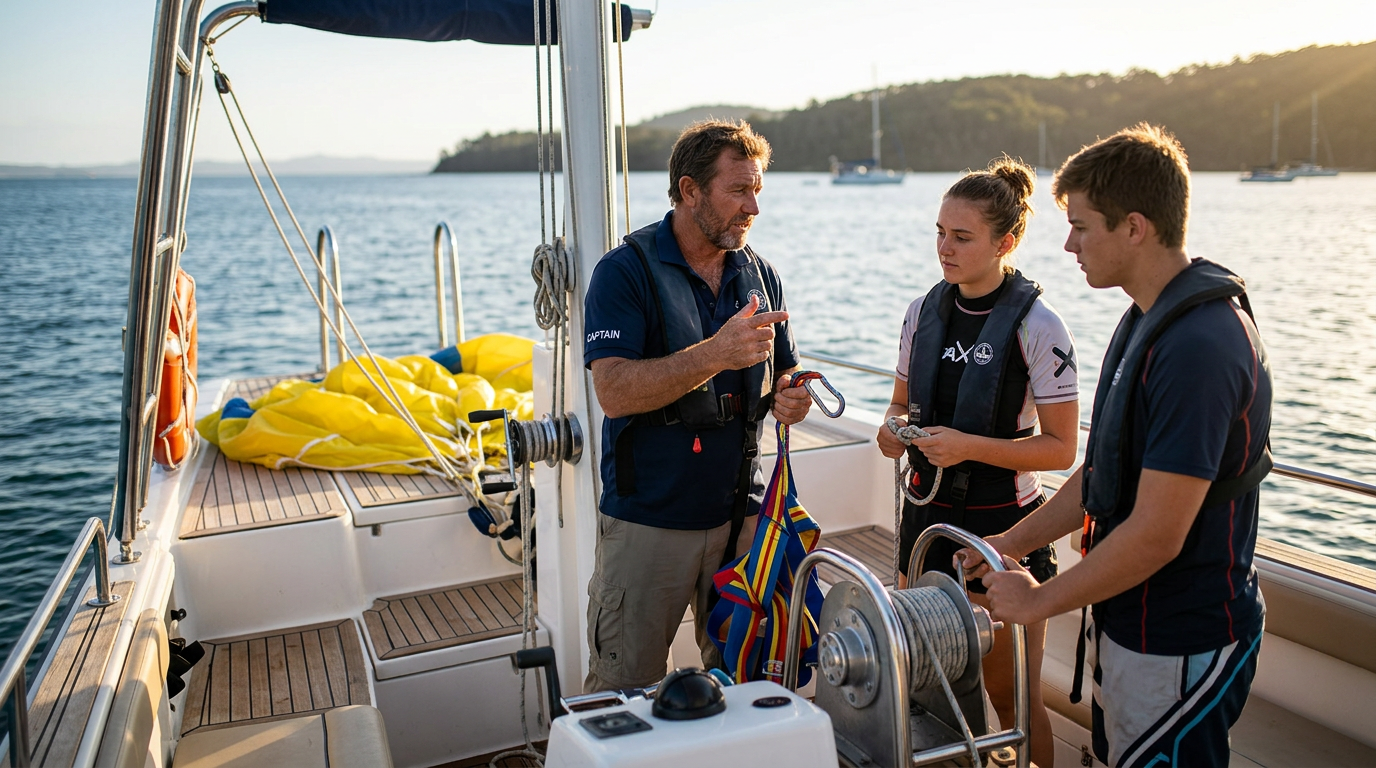
Crew Training Best Practices
In the highstakes world of parasailing, the difference between a flawless flight and a critical incident often comes down to one factor: crew training.…
In the high-stakes world of parasailing, the difference between a flawless flight and a critical incident often comes down to one factor: crew training. A well-drilled team is not just an asset; they are your primary defense against liability and the foundation of a profitable season. Investing in a robust, repeatable training program is the single most important operational decision an owner or captain can make.
Your vessel, whether it's a CWS Ocean Pro 35 or a custom-built Centurion, is only as safe as the people operating it. While captains bear the ultimate responsibility under USCG regulations, the deck crew is the hands-on link between the customer and the equipment. Their competence in harnessing, line handling, and passenger communication directly impacts safety, efficiency, and customer satisfaction. A structured crew training plan moves beyond informal, on-the-job learning and establishes a professional standard that protects your passengers, your equipment, and your business.
The Pillars of Parasail Crew Competency
A comprehensive training program must be built on a foundation of clearly defined roles and responsibilities. While every operation is slightly different, the core duties are universal. Training should be broken down into manageable modules that build upon each other, starting from day one.
The Deckhand's Domain
The deckhand is the primary point of contact for passengers on the flight deck. Their training must cover both technical skills and soft skills.
- Passenger Briefing and Harnessing: This is the first and most critical interaction. Crew must be trained to deliver a clear, confident safety briefing that covers what passengers can expect during launch, flight, and landing. They must demonstrate mastery in fitting harnesses for all body types, from small children to large adults, ensuring all buckles and straps are secure. A "triple check" system—where the crew member checks their own work, then has the captain or another crew member visually inspect—is a non-negotiable best practice.
- Line and Winch Management: Your deckhand is the winch operator's eyes and hands. Training must include:
- Line Inspection: Visually and physically inspecting the parasail line for frays, cuts, or UV degradation before the first flight of the day and between flights.
- Winch Operation: Smoothly paying out and retrieving the line under the captain's direction. Jerky movements can lead to line stress and passenger discomfort.
- Hand Signals: Perfecting the universal hand signals for "pay out," "hold," "retrieve," and "emergency stop." Verbal communication can be impossible over engine and wind noise, making clear signals vital.
- Launch and Recovery Operations: The deckhand orchestrates the physical launch and landing of passengers from the flight deck. They must know how to handle the canopy in various wind conditions, guide passengers into a seated position for a soft landing, and safely unclip the parasail assembly. This requires practice in calm and then progressively more challenging (but still safe) conditions.
Captain and Crew Synergy
The captain's role extends beyond piloting the vessel. They are the flight director and lead instructor. Captain training, which requires a minimum of a USCG OUPV (Operator of Uninspected Passenger Vessels) license, must incorporate crew oversight.
A captain must know how to perform every deckhand duty flawlessly. This allows them to effectively train new hires and spot procedural drift in experienced crew. Training drills should always involve both captain and crew, reinforcing communication and teamwork, especially for emergency scenarios.
From Novice to Pro: A Phased Training Approach
Bringing a new hire up to speed should follow a structured, documented process. Simply telling them to "watch and learn" is a recipe for inconsistency and unsafe habits.
Phase 1: Observation and Fundamentals (First 1-3 Days)
The new hire does not handle passengers or critical equipment. Their primary job is to observe, ask questions, and learn the basics.
- Boat Familiarization: Location of all safety equipment (fire extinguishers, life jackets, first aid kit), vessel systems (bilge pumps, batteries), and deck procedures.
- Knot Tying: Practice the essential knots until they can be tied quickly and correctly without thinking. This includes the bowline, cleat hitch, and a round turn with two half-hitches.
- Harnessing Practice: Use an experienced crew member or a training dummy to practice fitting and checking harnesses repeatedly.
- Manuals and SOPs: Read the company's Standard Operating Procedures (SOPs) and equipment manuals (e.g., for your CWS hydraulic winch system).
Phase 2: Supervised Practical Application (Weeks 1-3)
The trainee begins performing non-critical tasks under the direct, one-on-one supervision of a senior crew member or captain.
- Assisting with passenger harnessing, with every fitting double-checked by the supervisor.
- Handling dock lines when leaving and returning to the slip.
- Assisting with canopy management on the deck in light wind conditions.
- Calling out clearances and observing for other vessel traffic.
Phase 3: Independent Operation with Oversight (Weeks 3+)
Once the trainee has demonstrated competence and confidence, they can be cleared to perform tasks independently, but still under the captain's watchful eye. The captain and senior crew should continue to provide feedback, correct minor errors, and reinforce best practices. Regular spot-checks of harness fits and procedures are essential.
Incorporating Industry Standards and Certifications
Formalizing your training through industry-recognized programs adds a layer of professionalism and can positively impact your insurance premiums. The two main bodies in the US parasail industry are the WSIA and PAPO.
| Standard/Program | Watersports Industry Association (WSIA) | Professional Association of Parasail Operators (PAPO) |
|---|---|---|
| Focus | Broad watersports safety with a specific parasailing module. | Exclusively focused on parasailing best practices. |
| Methodology | Offers formal on-site and online certification courses. | Provides a detailed manual of operational standards. |
| Core Principle | Standardized, verifiable training for crew and captains. | Adherence to a strict, consensus-based set of operator rules. |
| Key Benefit | Widely recognized by insurance carriers; provides a framework. | Deeply specific guidance from seasoned industry veterans. |
Encouraging or requiring your crew to obtain a WSIA certification demonstrates a commitment to safety that resonates with both insurers and customers. Adhering to PAPO standards provides an invaluable playbook for day-to-day operations.
Drills, Documentation, and Continuing Education
Initial training is only the beginning. A truly professional operation prioritizes ongoing skill development and emergency preparedness.
- Emergency Drills: At least monthly, run drills for critical scenarios:
- Man Overboard: Practice recovery procedures for both passengers and crew.
- Winch Failure: Simulate a hydraulic failure and practice using the emergency backup system.
- Line Break: Discuss and walk through the procedure for a water landing and retrieval.
- Sudden Weather: Practice the procedure for quickly and safely retrieving the flyers and returning to port.
- Documentation: Maintain a training log for each crew member. This log should record the dates training modules were completed, drill participation, and any certifications earned. This documentation is invaluable in the event of an incident or an insurance audit.
- Annual Refreshers: Before the start of each season, hold a mandatory refresher course for all returning crew. This is the time to review SOPs, practice emergency drills, and introduce any new equipment or procedures.
Frequently Asked Questions
How long does it take to fully train a parasail deckhand?
This varies based on the individual's aptitude and prior marine experience, but a general timeline is 3-6 weeks. A trainee should not be considered "fully trained" until they can perform all duties confidently and consistently under various conditions, and have participated in multiple emergency drills.
What is the most common mistake new crew members make?
Rushing. In an effort to be efficient, new crew may rush through harness checks or passenger briefings. Training must emphasize a "slow is smooth, and smooth is fast" mentality. Taking an extra 15 seconds to double-check a buckle is always the right decision.
Are deckhands required to have a USCG Captain's License?
No. Only the person in command of the vessel is required to hold a USCG license (typically an OUPV or Master license for commercial parasailing). However, encouraging deckhands to work toward their license is a great career development path that benefits the entire operation.
Where can I find out more about official training and operational standards?
The best resources are the industry associations. Visit the websites for the Watersports Industry Association (WSIA) and the Professional Association of Parasail Operators (PAPO) for manuals, training opportunities, and membership information.
Bottom Line
Effective crew training is not a cost center; it's an investment in the safety, longevity, and profitability of your parasail operation. By establishing a documented, phased training program, incorporating industry standards from bodies like the WSIA, and committing to continuous drills and education, you create a culture of professionalism. This culture keeps your passengers safe, your crew confident, and your business thriving season after season.
Was this helpful?
Written by
Editorial Team
Related articles
How to Become a Parasail Captain
For many, the pinnacle of a day on the water is soaring under a colorful canopy, thousands of feet of line spooling out behind a powerful boat. But for…
Top Parasail Training Schools in the US
Earning a USCG Captain's License is a monumental achievement, but it's only the first step for anyone serious about entering the commercial parasailing…