Best Parasailing Boats for Beginners in 2025
Selecting your first vessel is the most consequential step in launching a commercial parasailing operation, directly impacting your safety, efficiency,…
Selecting your first vessel is the most consequential step in launching a commercial parasailing operation, directly impacting your safety, efficiency, and profitability. Finding the best parasailing boats for beginners involves balancing initial cost with long-term reliability and operational simplicity. This guide breaks down the essential features, leading models, and critical decisions you'll face when investing in the heart of your new business.
Key Considerations for Your First Parasail Boat
A purpose-built parasail boat is not just a powerboat with a winch bolted on; it's an integrated system designed for a specific, demanding task. For new operators, focusing on proven, industry-standard features is paramount.
Engine and Propulsion System
The engine is the workhorse of your operation. Unlike recreational boats where outboard gasoline engines are common, the commercial parasailing industry overwhelmingly relies on single inboard diesel engines.
- Torque: Diesel engines produce high torque at low RPMs, which is essential for getting a fully loaded boat on plane quickly and for providing the consistent power needed to operate the hydraulic winch system under load.
- Reliability & Longevity: Commercial-grade diesels from brands like Yanmar, Cummins, and Volvo Penta are built to run for thousands of hours with proper maintenance, a crucial factor for a business that operates daily.
- Fuel Efficiency: Diesel is typically more fuel-efficient than gasoline, leading to lower daily operating costs—a significant advantage over a long season.
- Safety: Storing diesel fuel onboard is generally considered safer than storing gasoline.
A typical 31- to 35-foot parasail boat will be equipped with a diesel engine in the 370 HP to 480 HP range. This provides ample power for a full complement of 12 passengers and crew while handling various sea conditions.
Winch System and Flight Deck
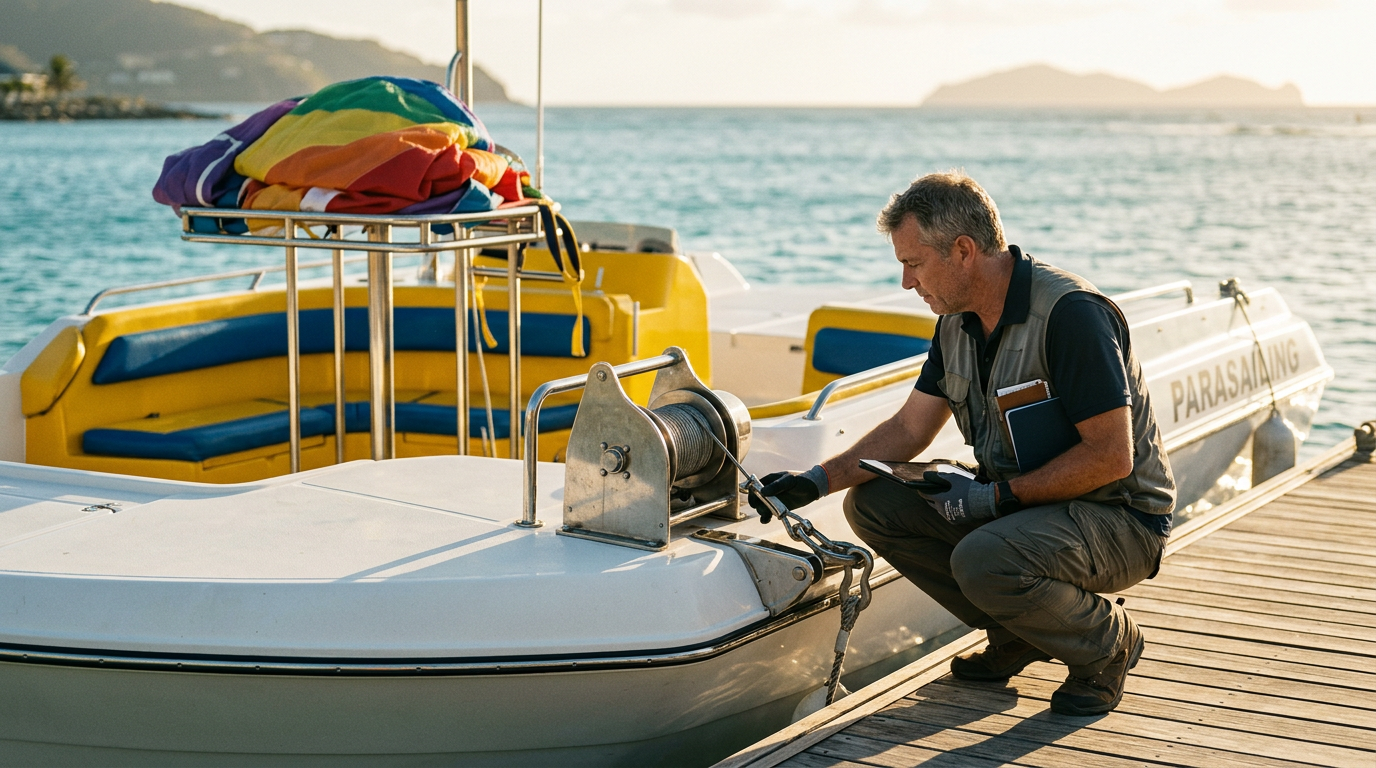
The parasail winch is a specialized piece of hydraulic equipment that pays out and recovers the towline. Its smooth and reliable operation is non-negotiable for safety. Reputable manufacturers like CWS (Commercial Water Sports) build winch systems directly into their boats. Key features include an automatic line-guiding system (levelwind) and emergency cut-off mechanisms.
Equally important is the flight deck layout. This is the aft section of the boat where passengers are harnessed and launched. A good flight deck for beginners should have:
- A large, clear, and unobstructed area.
- High-grip, non-slip surfaces.
- Ergonomic seating for passengers waiting to fly.
- Excellent visibility for the captain to monitor the flight deck and the parasail simultaneously.
Hull Design and Stability
Parasail boats need to perform two contradictory tasks well: cut through choppy water while underway and remain stable at rest. A deep-V hull design is standard, allowing the boat to handle wind and waves comfortably, providing a better experience for passengers.
However, a boat that is too "rolly" at rest can make the launch and recovery process difficult and uncomfortable for guests. Manufacturers spend considerable effort balancing a sharp entry for wave-cutting with beamy stability. All new commercial parasail boats sold in the U.S. must meet U.S. Coast Guard (USCG) stability and construction standards for their certified passenger capacity.
Passenger Capacity and USCG Certification
This is a critical regulatory point. Most purpose-built parasail boats are designed to carry up to 12 passengers plus a captain and crew member. Operating a vessel with more than six passengers for hire requires the captain to hold a USCG Master Captain's License and the vessel to have a Certificate of Inspection (COI).
For a beginner, purchasing a boat already built to USCG COI specifications for 12 passengers is the most straightforward path. This avoids the costly and complex process of trying to certify a vessel that wasn't designed for it from the start. It's far easier to operate with fewer passengers on a 12-passenger boat than it is to be limited to six passengers when demand is high.
Top Parasail Boat Models for New Operators
For new operators, sticking with the industry's most reputable builders ensures you're getting a proven platform with good resale value and parts availability. The two dominant names in the U.S. market are Ocean Pro Marine and CWS.
| Model | Manufacturer | Typical Engine | Passenger Capacity | Key Feature for Beginners | Estimated Price (New) |
|---|---|---|---|---|---|
| Ocean Pro 31' | Ocean Pro Marine | Yanmar/Volvo Diesel (370-440 HP) | 12 + 2 Crew | The industry standard; known for its simple, rugged reliability and excellent resale value. | $190,000 - $220,000 |
| Ocean Pro 35' | Ocean Pro Marine | Yanmar/Volvo Diesel (440-480 HP) | 12 + 2 Crew | More space and a smoother ride in rougher water compared to the 31', ideal for coastal areas with more chop. | $230,000 - $260,000 |
| CWS Ocean Wolf 33' | CWS | Yanmar/Volvo Diesel (370-480 HP) | 12 + 2 Crew | Highly regarded for build quality, integrated CWS winch system, and often features a modern, comfortable layout. | $210,000 - $250,000 |
| Used Custom 31'-34' | Various | Various Diesel | 6 or 12 + Crew | A potential entry point at a lower cost, but requires extreme due diligence (survey, engine history). | $70,000 - $150,000 |
New vs. Used: A Financial Primer for Beginners
The decision to buy new or used will be driven by your startup capital.
Buying New
- Pros: Full manufacturer's warranty, latest safety and engine technology, customizable options (colors, electronics), no hidden history, easier to finance.
- Cons: Higher initial investment ($190,000+), potential manufacturing lead times of several months.
Buying Used
- Pros: Significantly lower upfront cost, boat is available immediately.
- Cons: No warranty, risk of pre-existing mechanical or structural issues, potentially outdated technology, may require expensive refitting to meet current safety standards (e.g., WSIA or PAPO guidelines), financing can be more difficult.
If you consider a used boat, hiring a qualified marine surveyor with experience in commercial passenger vessels is non-negotiable. They should perform a full out-of-water survey, a sea trial, and arrange for an engine-specific survey by a certified diesel mechanic. Check engine hours—a well-maintained commercial diesel can last 10,000+ hours, but a poorly maintained one can be a money pit.
Frequently Asked Questions
What is a realistic budget for a fully equipped, turnkey new parasail boat?
For a new, 31- to 33-foot vessel from a top manufacturer, complete with engine, winch system, basic electronics, and trailer, a realistic budget for 2025 is between $200,000 and $250,000. This does not include parasails, harnesses, or other operational gear.
How important is the engine brand?
While a well-maintained engine is more important than the brand itself, Yanmar and Volvo Penta are the dominant players in this market for a reason. They have a strong reputation for reliability and have extensive service networks, which is crucial for minimizing downtime during your peak season.
Do I need a special license to operate a parasail boat?
Yes. To carry up to six paying passengers, you need a USCG Operator of Uninspected Passenger Vessels (OUPV) license, often called a "6-pack" license. To carry more than six passengers (which most commercial boats are certified for), you must have a USCG Master License of at least 25-ton capacity. All crew should also be trained in parasailing operations, with many operators adhering to standards set by the Professional Association of Parasail Operators (PAPO) or the Water Sports Industry Association (WSIA).
Can I convert a regular sport boat for commercial parasailing?
This is strongly discouraged and generally not feasible. A commercial parasail boat is a purpose-built system. The hull is reinforced to handle the stress from the winch, the hydraulic system is integrated, and the flight deck is specifically designed for safe operations. Attempting to retrofit a recreational boat will likely not meet USCG requirements for commercial use and would be inherently unsafe.
Bottom Line
For a beginner entering the commercial parasailing industry, the smartest investment is a new or lightly-used, purpose-built vessel from a reputable manufacturer like Ocean Pro Marine or CWS. These boats are designed from the keel up for safety, reliability, and efficiency. While the initial cost is significant, their proven track records, compliance with USCG standards, and strong resale value provide the most stable foundation for building a successful and safe operation.
Was this helpful?
Written by
Editorial Team
Related articles
Buying Your First Parasail Boat: A 2025 Guide
Taking the helm as an owneroperator after years as a hired captain is a landmark achievement in the commercial watersports industry. The single most imp…
How Much Does a Parasailing Boat Cost? Complete Price Guide
Determining the true parasailing boat cost is the most significant financial calculation for any commercial watersports operator. More than just a vesse…
The Used Parasail Boat Inspection Checklist
A gleaming, preowned parasail boat can seem like a shortcut to profitability, but a bargain price can quickly evaporate into a sea of unforeseen repairs…