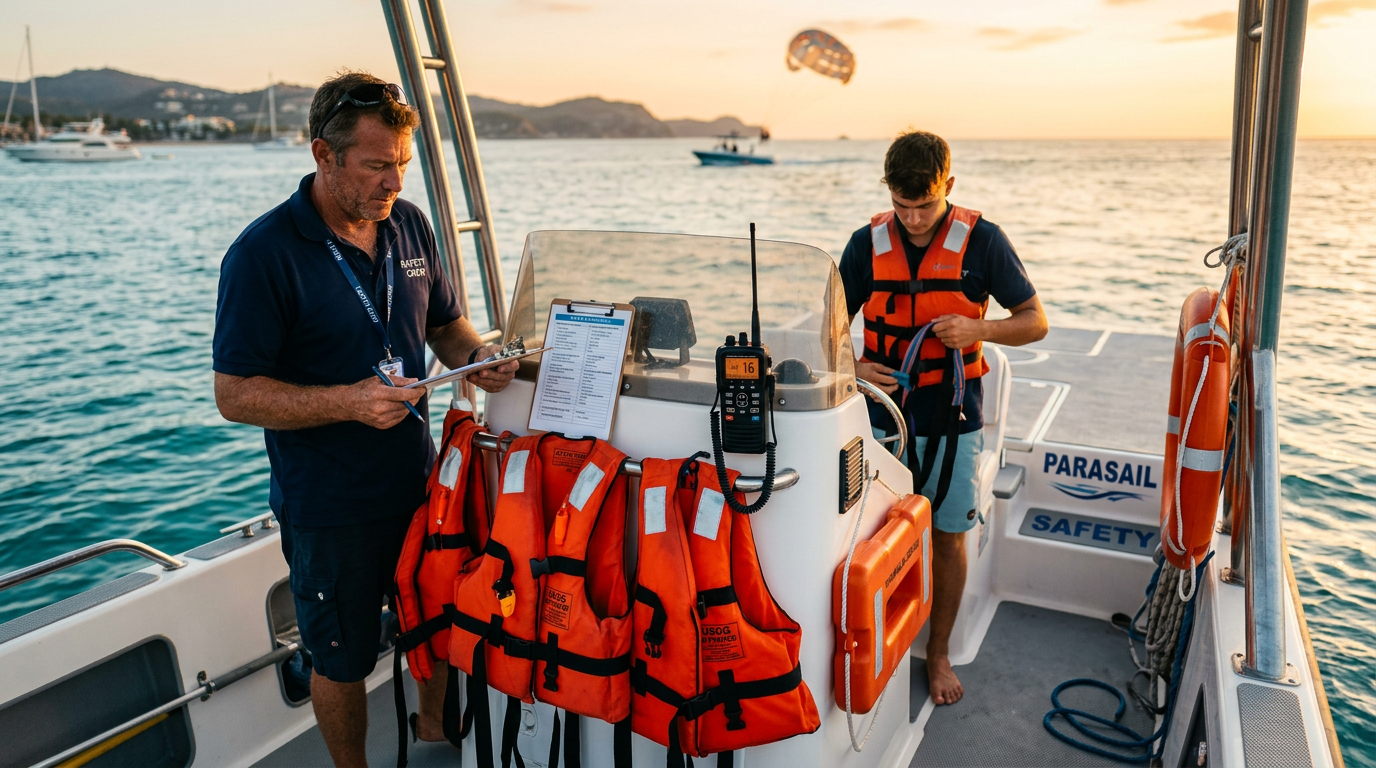
The Pre-Flight Safety Checklist Every Operator Needs
In the highstakes world of commercial parasailing, where customer thrills and operational risks are two sides of the same coin, a rigorous preflight saf…
In the high-stakes world of commercial parasailing, where customer thrills and operational risks are two sides of the same coin, a rigorous pre-flight safety checklist is the single most important tool in your arsenal. It is more than just a list to be ticked off; it is a systematic, repeatable process that protects your passengers, your crew, your equipment, and ultimately, your business's longevity. Complacency is the enemy, and this structured daily routine is its cure.
Why a Standardized Checklist is Non-Negotiable
The temptation to cut corners on a busy summer day is real. When the dock is full and the sun is high, it's easy for an experienced captain to think they can spot a problem by feel or intuition alone. This is a dangerous fallacy. Human memory is fallible, and complacency breeds in familiarity. A standardized, physical or digital checklist ensures that nothing is overlooked, from the simplest cotter pin to the most complex hydraulic system.
From a business perspective, the benefits are threefold:
- Liability & Insurance: In the unfortunate event of an incident, documented and completed daily checklists are invaluable. They demonstrate a commitment to professional standards and due diligence to insurers and legal counsel. The absence of such records can be catastrophic in a legal dispute.
- Regulatory & Industry Compliance: While the USCG has overarching authority on vessel safety, specific parasail regulations often exist at the state level, like Florida's comprehensive "White-Miskell Act." Furthermore, industry bodies like the Water Sports Industry Association (WSIA) and the Professional Association of Parasail Operators (PAPO) set the gold standard for operational safety, and their guidelines are built around the concept of a thorough pre-flight inspection.
- Asset Protection: A multi-hundred-thousand-dollar parasail boat, like a CWS Ocean Pro 35 or a Custom Chute Boat, is a significant investment. Daily checks on the engine, winch system, and of course, the several-thousand-dollar parasail canopy itself are fundamental to preventative maintenance, reducing costly downtime and extending the life of your equipment.
The Three Pillars of the Pre-Flight Check
A comprehensive pre-flight safety checklist can be broken down into three core areas. This segmented approach ensures that the captain and crew can focus their attention methodically, reducing the chance of oversight.
- Pillar 1: Vessel Systems: The boat itself, from engine to electronics.
- Pillar 2: Parasail Flight Equipment: The canopy, line, harnesses, and all connecting hardware.
- Pillar 3: The Environment & People: Weather conditions, crew readiness, and passenger preparedness.
Pillar 1 Breakdown: Vessel Systems Check
Before the first customer steps aboard, the boat must be verified as safe and ready. This check should happen dockside every single morning.
- Engine & Mechanical: Whether you're running twin Yamaha 300s or a single diesel inboard like a Yanmar or Cummins, the engine is the heart of the operation.
- Check engine oil and transmission fluid levels.
- Visually inspect belts and hoses for cracks, wear, or leaks.
- Check coolant levels in freshwater-cooled systems.
- Verify fuel levels and check for water in the fuel separator.
- Start the engine and listen for any unusual noises, vibrations, or warning indicators.
- Winch & Hydraulics: The winch is your most specialized piece of machinery.
- Check the hydraulic fluid reservoir level and inspect all hoses and fittings for leaks.
- Inspect the condition of the winch drive belt.
- Examine the winch drum and level-wind mechanism to ensure the line is spooled correctly and not pinched.
- USCG-Required Safety Equipment: This is a non-negotiable legal requirement.
- Confirm the correct number of PFDs (Type I, II, or III as appropriate) for your maximum passenger and crew capacity. Check for wear and tear.
- Ensure all fire extinguishers are in the green, properly mounted, and accessible.
- Check expiration dates on visual distress signals (flares).
- Verify the first aid kit is fully stocked.
- Conduct a radio check on a working channel and ensure VHF Channel 16 is monitored.
- Deck & Hull:
- Operate bilge pumps (both auto and manual) to confirm function.
- Ensure decks are clean, non-slip surfaces are intact, and no trip hazards are present.
- Check that all passenger seating is secure.
Pillar 2 Breakdown: Parasail Flight Equipment
This is the gear that directly connects your customer to the boat. It requires meticulous, hands-on inspection. Any piece of equipment that appears worn, damaged, or questionable must be immediately retired and replaced.
The Chute
Examine the parasail canopy laid out on the deck. Check for any rips, tears, abrasions, or broken stitches. Pay special attention to the seams and the areas around the vents and bridle attachment points. A small tear can become a catastrophic failure under load.
The Line
The towline is arguably the single most critical piece of safety equipment. It requires daily inspection along its entire working length (typically the first 300-400 feet).
- Abrasion: Look for fuzzy or chafed areas.
- UV Degradation: Feel for stiffness and look for discoloration (often yellowing). A healthy line is supple.
- Knots & Twists: Never fly with a knot in the line. Any knot can reduce the line's breaking strength by up to 50%.
- Flat Spots/Glazing: Caused by friction, these are weak points that must be taken seriously.
WSIA guidelines recommend a line strength of at least 4,500 lbs for single/tandem operations and 6,000 lbs for triples. Lines have a finite life based on flights and exposure, and they should be retired according to manufacturer recommendations (e.g., every 500-700 flights) or at the first sign of significant wear.
The Harnesses & Hardware
- Harnesses: Inspect all webbing for cuts, fraying, or UV damage. Check all stitching, especially around load-bearing points. Operate every buckle to ensure it latches and releases correctly.
- Hardware: Physically inspect every carabiner, swivel, and tandem/triple bar. Look for cracks, corrosion, and distortion. Ensure carabiner gates self-close and lock properly. Only use load-rated, marine-grade (316 stainless steel) hardware from reputable manufacturers.
Pillar 3 Breakdown: Environment & People
Weather Awareness
This is a continuous process, but it begins with a formal pre-departure check.
- Review marine forecasts from reliable sources (NOAA).
- Use an anemometer to get a current wind speed reading at your location. Operations are typically ceased when sustained winds exceed 15-20 MPH, with gusts being a major concern.
- Scan the horizon for signs of developing weather, particularly thunderstorms. Remember the "30-30 Rule" for lightning safety.
Crew Brief & Passenger Briefing
Confirm your captain and mate are on the same page regarding hand signals, emergency procedures (e.g., man overboard, winch failure), and daily responsibilities. The passenger safety briefing is a vital part of the checklist; it must be delivered clearly and concisely before every trip, covering harness fitting, body position, and what to expect during the flight.
Checklist Formats: Digital vs. Analog
| Feature | Paper/Laminated Checklist | Digital App/Tablet Checklist |
|---|---|---|
| Initial Cost | Very Low ($0 - $20) | Moderate ($200+ for a rugged tablet) |
| Durability | Prone to water damage, wear, and tear | Excellent with a waterproof/rugged case |
| Record Keeping | Manual filing, harder to track long-term | Automatic, cloud-based, easily searchable |
| Accessibility | Easily lost or damaged | Accessible across multiple devices |
| Customization | Requires reprinting to update | Easily edited and updated in real-time |
| Accountability | Susceptible to "pencil whipping" | Can require photos, time-stamps, and geo-tags |
Frequently Asked Questions
How often should a parasail towline really be replaced? While manufacturers often give a flight count (e.g., 500-700 flights), the real answer is: replace it as soon as it shows signs of degradation. A line used in harsh, sunny conditions with saltwater may only last one season, regardless of flight count. Daily visual and tactile inspection is more important than a number in a logbook. When in doubt, swap it out.
What are the absolute maximum wind speeds for safe parasailing? This is set by company policy but guided by WSIA standards. Most professional operators set a limit of 15-18 MPH for sustained winds and will not operate with gusts exceeding 20-22 MPH. Critically, operations must cease well before a storm front, with its unpredictable and powerful wind shear, arrives. It is not safe to "outrun" a storm.
Are there federal regulations for pre-flight checklists? There is not a specific federal law mandating a parasail-specific checklist. The USCG mandates general vessel safety checks. However, states with high tourism, like Florida, Hawaii, and New Jersey, have specific statutes governing parasail operations which often require adherence to WSIA standards, including documented daily equipment inspections. For all intents and purposes, it is a required industry standard of care.
What is the most commonly overlooked item on a pre-flight check? Subtle equipment degradation is often missed. This includes minor harness webbing abrasion hidden under a buckle, the beginnings of UV damage on a towline that still "feels okay," or a tiny stress crack forming on a carabiner. This is why a hands-on, methodical check in good light is crucial, rather than a cursory glance.
Bottom Line
A pre-flight safety checklist is not a box-ticking exercise; it is a culture of safety. It's the disciplined practice that separates true professionals from amateurs. Diligent adherence to this daily ritual is the best insurance an operator has, ensuring that every flight concludes safely and every customer leaves with a smile and a story to tell, paving the way for a successful and sustainable business.
Was this helpful?
Written by
Editorial Team
Related articles
Weather Decision-Making for Parasail Operators
Of all the calculations a parasail captain makes in a day, none is more critical than the constant evaluation of the sky and sea. The most successful an…
Learning from Past Parasail Incidents
While our industry boasts an impressive safety record overall, a close examination of past parasail incidents reveals a handful of repeating, preventabl…

Parasailing Safety Equipment Checklist (Complete Guide)
The definitive parasailing safety equipment checklist every captain should run before each flight day.